
Union County 72-Hour Record Window
Neither the Union County Sheriff website nor the official Pulaski County Detention Center page offers a rolling 72-hour release list. There is no supported online window, publication schedule, field set, or retention period. The accurate local approach is to create a precise three-day interval and seek the records maintained for it.
A request should state calendar dates and local start and end times. For example, define the first date at midnight and the third date at 11:59 p.m. This removes doubt about whether “last 72 hours” means a rolling period counted backward from receipt or three complete calendar days. It also gives the custodian a clear search range.
Union County’s unusual detention structure makes that field essential. IDOC inspection evidence says Pulaski houses Union prisoners under contract. The Illinois Sheriffs’ Association lists no Union county-jail address. Thus, absence from a Union web page is not evidence of release.
Check Union County Three-Day Releases
A three-day inquiry works best as a record reconstruction. Start with the arresting county, follow the person to the actual jail, and compare that physical-custody record with the court decision. Use state or federal systems only if the local record points there.
- Write down the exact three-day interval, the person’s full name, date of birth if known, and any case or booking number.
- Ask Union County Sheriff at 618-833-5500 which agency held the person during that period and whether Union has arrest or transport records.
- Contact Pulaski County Detention Center at 618-845-3512 when Ullin was the custodian. Ask for community release versus transfer.
- Review the Union County court case index or call the Circuit Clerk at 618-833-5913 for orders and dispositions entered during the interval.
- Check Illinois VINELink for a matched custody event, but confirm its meaning and time with the reporting agency.
The Released Last 24 Hours method is better when only the current day matters. A three-day request is designed for a broader span and should not be reduced to checking one live status at the end of the period.
Union County Three-Day Release Fields
No online display exists, so the field set must be requested. Ask for an electronic extract if the agency keeps one. A PDF may preserve the source record, while a CSV can make multiple entries easier to sort. Do not demand a format the office does not maintain.
| Field | Use in a 72-hour review |
|---|---|
| Name and booking number | Separates people with similar names and links each event. |
| Booking date and time | Shows whether custody began inside or before the window. |
| Release date and time | Places the completed event inside the requested period. |
| Release type or disposition | Explains the recorded outcome without relying on an “out” label. |
| Destination or receiving agency | Separates community release from jail, state, or federal transfer. |
| Case or charge reference | Connects the detention event with the correct Union court file. |
Ask for all reasonably segregable nonexempt information if part of a record must be withheld. Juvenile, medical, victim, security, personal, and active-investigation details can be restricted or redacted. A partial response should not be treated as a complete public history.
Union County Weekend Release Timing
A three-day span is useful around weekends because the legal decision and the facility event may appear in different records and at different times. A signed court order authorizes the legal outcome. It does not prove that detention staff completed identity checks, property return, medication documentation, and final processing at that same moment.
If an order was entered late on one day, the physical release entry may be recorded later. A holiday can also delay access to office staff or the response to a written records request. There is no verified local publication cadence that permits a promise about when an event would appear online. In fact, there is no official feed at all.
Compare records instead. The court docket can show detention, release, dismissal, sentence, probation, or commitment. The Pulaski release sheet supplies the actual departure time and destination. Union sheriff records can explain transport or custody routing.
Note: Use event dates, not the date a clerk answers the request, when deciding whether an entry belongs within the three-day period.
Union County 72-Hour FOIA Request
The Union County FOIA page says anyone may request records. A written request should seek booking and release entries for the defined dates, including the actual timestamp, disposition, and receiving agency. The county form is the simplest route, but another written request must also be honored.
Union County’s Public Information Officer is at 309 W. Market Street, Room 239, Jonesboro, IL 62952. Requests may be emailed to foia@unioncountyil.gov, and the listed phone is 618-833-8248. The county describes five business days for an ordinary response, subject to lawful extension. Its first 50 printed black-and-white pages are free; later pages are $0.15 each.
Split the request when the records are split. Union may hold the arrest or transport material. Pulaski may hold the booking/release sheet created in Ullin. Pulaski’s official detention page links its FOIA route and lists gjones@pulaskicountyil.gov. Ask for a cost estimate before fees and request electronic delivery where maintained.
Why Union Release Absence Misleads
Union County does not operate a conventional public jail roster. The official directory’s “County Jail Address: N/A” notation is not a status result for any person. It describes the county’s facility footprint. A newer IDOC inspection supplies the other half of the picture by documenting Pulaski’s contract housing of Union prisoners.
The Illinois Sheriffs’ Association directory is the source for that local jail-address notation.
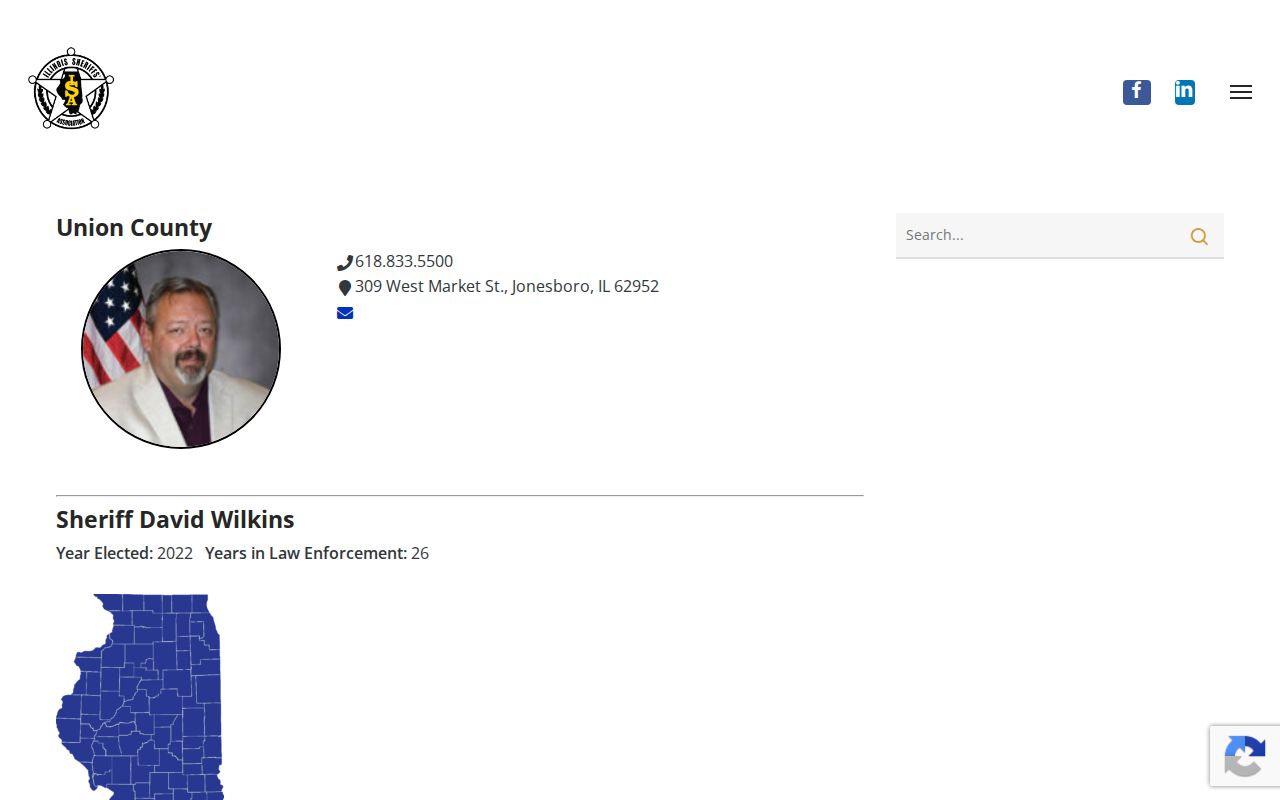
The image supports the need to follow custody across county lines. It does not establish any named person’s release.
A missing local result can mean that no roster exists. A missing IDOC result can mean the person never entered state prison. A missing VINE result may reflect spelling, participation, or timing. Only positive matched evidence should be used to label a community release.
Resolve Union Release Conflicts
Three days can contain several linked events. A person may be ordered released, remain briefly at Pulaski for processing, then leave. Another person may disappear from Pulaski because of transfer to IDOC. A third may move under a U.S. Marshals matter. Treat each agency record as an answer to a distinct question.
| Source | Question answered | Limit |
|---|---|---|
| Pulaski release sheet | When and how did custody at Ullin end? | It may describe transfer, not freedom. |
| Union court docket | What legal order or disposition was entered? | An order time is not the final processing time. |
| Union Sheriff record | Which agency arrested, moved, or received the person? | Union may not hold Pulaski-created jail records. |
| VINE event | Was a custody change reported? | Data can lag and requires agency confirmation. |
| IDOC profile | Did the person enter or leave Illinois prison custody? | It is not a complete local-jail archive. |
When details disagree, contact the agency closest to the disputed event. Ask Pulaski about its timestamp, Union Circuit Clerk about its order, and IDOC about a state status. Do not merge unlike dates into a single “release date.”
Union Release Paths After Pulaski
A community release may follow a Union court order, completion of a local sentence, dismissal, acquittal, or another lawful disposition. Illinois pretrial matters should be read through current court orders rather than old cash-bail language. Union’s Office of Statewide Pretrial Services provides local supervision contact information and states that pretrial supervision and GPS services are free.
A transfer follows another route. An IDOC mittimus sends a sentenced person into state custody. The IDOC Individual in Custody Search then becomes relevant. “PAROLE” means supervised community placement, not final sentence discharge. A federal movement may require PACER or the federal court clerk because a USMS pretrial detainee may not yet appear in the BOP locator.
The receiving-agency field resolves these paths. Without it, a three-day extract can overstate how many people returned to the community.
Older Union Release Records
No official source says how long a local release remains visible online because there is no online release archive. Documentary retention follows applicable local-records rules and approved schedules. The Pulaski inspection indicates permanent retention of a signed itemized property receipt used in its release process, but that does not establish one retention term for every booking or release record.
For an older event, ask the custodian which schedule applies to the booking sheet, release entry, photograph, and related property receipt. Sealed, expunged, juvenile, or otherwise restricted material may not appear through ordinary public access. A no-result therefore cannot prove that no event occurred.
Records should be framed by their source and scope. A three-day list requested today is a snapshot of entries produced by a custodian, not a permanent universal database.