
Union County Projected Versus Actual Release
A projected date is a calculated milestone. It is not the timestamp when a person leaves a facility. IDOC profiles may show Projected Parole Date and Projected Discharge Date. The first concerns anticipated movement from secure prison custody into supervised community placement. The second concerns the expected end of the sentence and supervision. Neither should be renamed or treated as an actual release field.
A pretrial detainee has no sentence-based projected date. Release depends on a Union County court order, resolution of any holds, and processing by the custodian. Because Union detainees are housed under contract at Pulaski County Detention Center, the court creates the legal authority while Pulaski may document the physical event.
Find Union County Inmate Release Dates
First identify whether the person is in pretrial custody, serving a local jail term, or committed to IDOC. The Union County release-record search path connects those systems. Do not use IDOC as a complete local jail archive because it covers people committed to state prison.
- Search the Union criminal case by name or case number and read detention, sentence, jail-credit, and mittimus entries.
- For local custody, call Union Sheriff to identify the custodian and ask Pulaski for the release calculation or actual release record.
- For state prison, open the IDOC Individual in Custody Search.
- Search by Last Name, IDOC Number, or Birthdate, then match identity and sentencing county.
- Read Offender Status, Admission Date, Projected Parole Date, Last Paroled Date, and Projected Discharge Date together.
- Confirm near the expected date with the agency that controls custody.
An IDOC number is safer than a common surname. One sentencing row marked “Sentence Discharged? YES” does not prove that all sentences ended. Review every active row and current status.
Illinois Credits Shape Union Release Dates
Illinois sentence credit is governed by 730 ILCS 5/3-6-3. The statute contains offense-specific rules. Some prison terms receive day-for-day credit unless another rule applies. Certain listed offenses require a greater share of the term to be served, including provisions often described as 85 percent service. Other serious offenses can have still different treatment.
Credit is not a single percentage that can safely be applied to every Union County sentence. IDOC calculates the prison date from the mittimus, custody credit, sentence structure, applicable statutory category, and earned or lost credit. Consecutive sentences also change the math. A public profile reflects the agency's current calculation but can change after corrected data or discipline.
Local jail time is different. No Union or Pulaski source supplied a public county good-time formula or online calculator. Do not import IDOC prison calculations into a Pulaski local sentence. Ask the Circuit Clerk for the sentence and credit order, then ask the custodian how it applied that order.
Why Union County Release Dates Change
A date can move in either direction. A new award or verified custody credit can shorten the calculation. Lost credit, an added consecutive term, or a hold can delay community release. A corrected mittimus may change the date without changing the underlying conviction.
| Factor | Possible effect |
|---|---|
| Custody or sentence credit | Changes time remaining after agency review. |
| Discipline | Loss or later restoration of available credit may alter the projection. |
| Detainer or warrant | Departure from one facility may become transfer to another agency. |
| Amended court order | Changes the legal sentence data used by the custodian. |
| Consecutive sentence | Adds another term to the calculation. |
| Parole or MSR revocation | May return a person to custody and recalculate release. |
A detainer is a request or notice that another authority may take custody. It does not always change the date the current facility closes its record, but it can prevent release to the community. Ask the release record to name the receiving agency.
Confirm Union County Actual Release Dates
For a local case, compare the Union court order with Pulaski's booking and release sheet. The sheet should provide the actual release timestamp, disposition, and receiving agency if transferred. Union Sheriff records may document arrest and transport, while Pulaski may hold the physical departure record. Narrow requests to both custodians may be needed.
For an IDOC case, check current Offender Status close to the projected date and use the public information line when written certainty is needed. “PAROLE” means the person has left secure prison custody under supervision. It does not mean the sentence is discharged. “IN CUSTODY” or “RECEPTION” means the projected milestone has not become community release.
A Union County VINELink release alert can provide notice of a pending custody change. VINE is supplementary. Confirm the event with the reporting agency because transfer, lag, or a second hold can affect the result.
Read Union County IDOC Date Fields
The IDOC profile separates admission, parole, and discharge information. Admission Date marks entry into the state system. Projected Parole Date is a forecast of a prison-release milestone. Last Paroled Date records a prior event. Projected Discharge Date looks toward the end of sentence and supervision.
Current Offender Status controls interpretation. A last-paroled date beside an in-custody status may reflect a later revocation. A parole status shows supervised community placement. An absconder status is not discharge and should be checked with official authorities.
The official IDOC search page shows the search inputs used for this state-prison path.
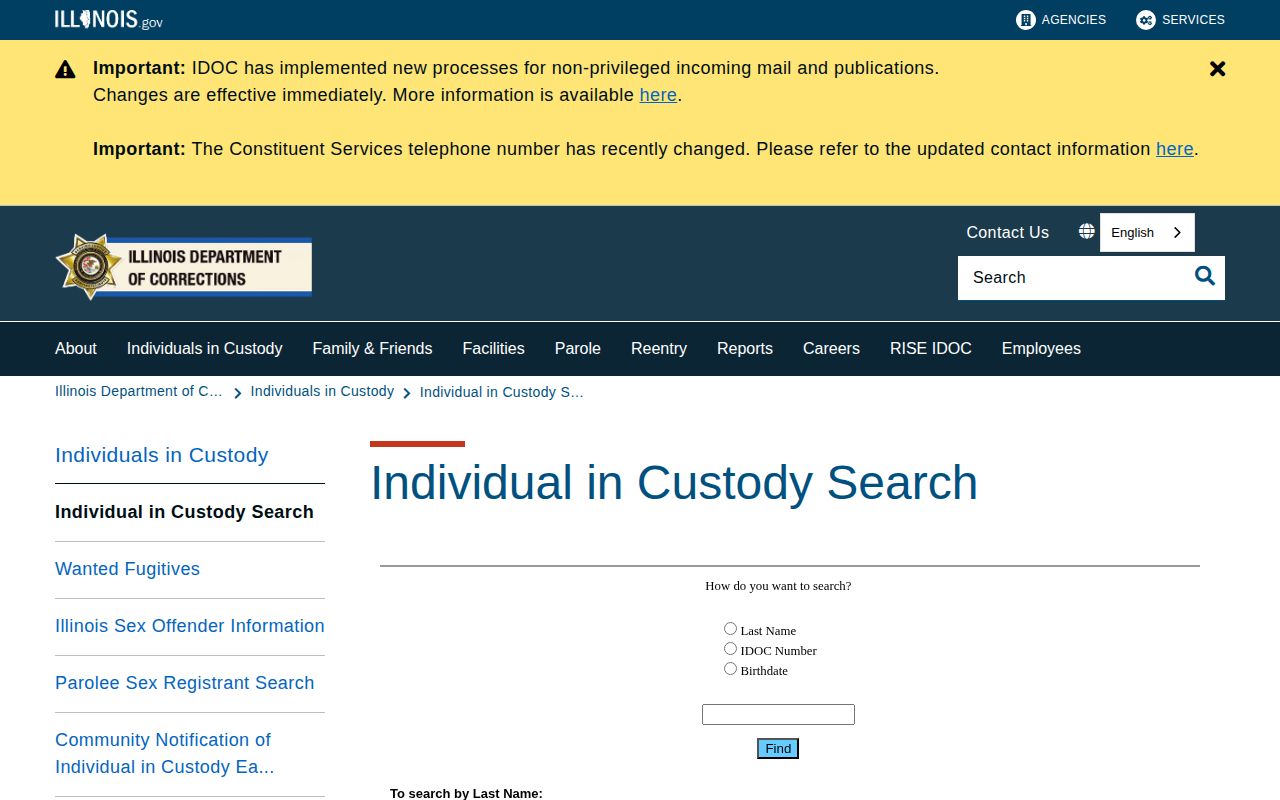
The landing screen reinforces that Last Name, IDOC Number, and Birthdate are the approved inputs. Use the profile result, not a guessed calculation.
No Union County Release Calculator
No official Union or Pulaski source provides a public local-jail projected-release calculator, county good-time formula, weekend release rule, or routine release-processing schedule. That absence is itself important. A date generated from a generic calculator would not account for the actual order, credit, holds, or contract custodian.
Use a purpose-neutral written request. Ask for the sentence calculation, credited days, actual or projected release date if maintained, and any disposition that changes community release to transfer. If part is withheld, request all reasonably segregable nonexempt material and the basis for redaction.
Note: Recheck the controlling agency near the projected date because credits, holds, and court orders can change the result.
Request Union County Date Calculations
When no public profile supplies the needed field, request the record maintained by the correct agency. For a local case, ask Union County for the mittimus, transport, or arrest record it holds and ask Pulaski for the jail calculation and release event it created. State which booking and date range are involved.
Union County says written FOIA requests may be made without its form, though the form is the simplest route. Ordinary noncommercial requests receive a response within five business days, subject to a lawful extension, fee notice, redaction, or denial explanation. The first 50 printed black-and-white pages are free and later pages cost $0.15 each. Electronic delivery can avoid needless copying.
For an IDOC sentence, the department's FOIA officer accepts requests at DOC.FOIARequest@illinois.gov and by mail at 1301 Concordia Court, P.O. Box 19277, Springfield, IL 62794-9277. Ask for the release or discharge date and type, or a nonexempt release-card record, rather than an entire master file. IDOC states a five-working-day response framework with a possible written extension.
A clear request seeks the calculation as maintained, not a new calculation created for the requester. Include the name, IDOC or booking number, sentencing county, and approximate date. Ask for segregable nonexempt material if part of the record is withheld.
Union Court Orders and Release Timing
The Union County docket can show pretrial release, detention, dismissal, sentence, custody credit, probation, or a mittimus to IDOC. Each entry changes how a date should be read. A dismissal on one case does not clear a separate warrant or hold. A time-served sentence still requires the custodian to complete release processing.
A signed order has a legal timestamp, but it does not prove that Pulaski finished identity checks, property return, medication documentation, and departure at that moment. Ask for the jail's actual release time. If the disposition is transfer, record the receiving agency rather than describing the event as community release.
The Circuit Clerk may also clarify amended orders that changed the calculation after an earlier projection. Compare the newest order with the current custodian's record. This two-source check is the best way to separate a scheduled date, legal authority, and actual movement.
Save Union County Date Sources
Keep the date checked with each IDOC profile, court entry, or jail response. An old projection can remain in a saved copy after the agency recalculates it. A current source date helps distinguish a prior estimate from the status now maintained by the custodian.